April 23rd, 2026
New
Improved

Release 0.11.1
Athlete profile ✨
We’ve launched a new Athlete profile page in Settings for runner accounts, designed to power KULG Training Intelligence in providing personalised training guidance. The profile now includes the new Performance & physiology section as well as the HR zones (PBs are coming soon!).
Under the Performance & physiology section, athletes can add and manage key data, including their physical profile (weight, height, body fat %, resting HR), lab metrics (max HR, lactate threshold HR, VO₂max), threshold pace data, and hematology values (hemoglobin, hematocrit). Entries can be saved by date and edited or deleted at any time.
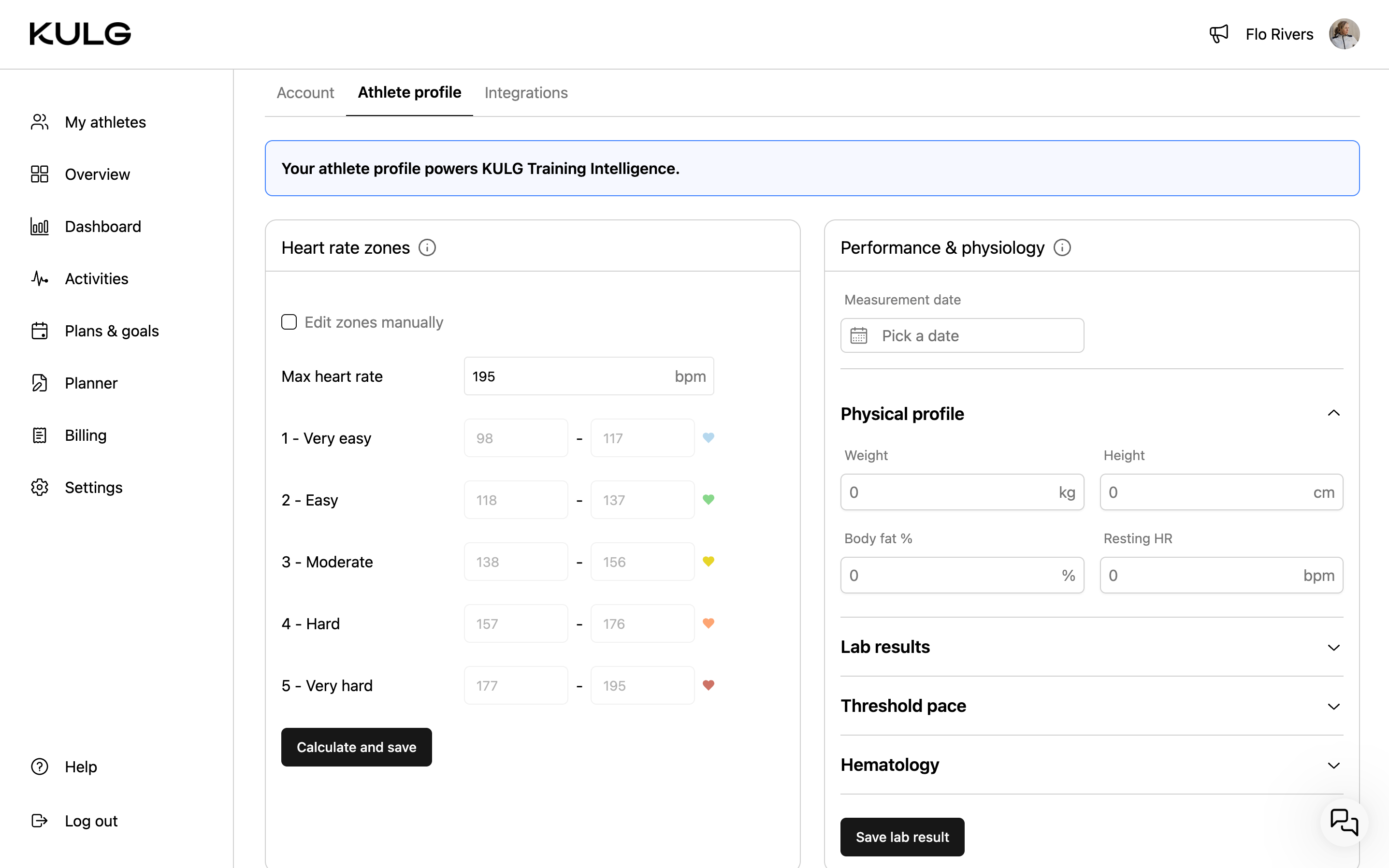
This data is used to generate more tailored weekly and monthly AI insights and will power future adaptive training guidance. The more complete your profile and the more you add feedback to your activities on how you felt during training, the more precisely KULG can adjust recommendations to your individual physiology, performance, and recovery.
Max HR, lactate threshold, and VO₂max are also used to calibrate heart rate zones. If unavailable, zones are estimated from activity history unless manually set. For best accuracy, we recommend using lab-tested values where possible, as wearable estimates (especially VO₂max) may be less precise.
NB! For aerobic threshold (AeT), include heart rate corresponding to LT1 (first lactate/ventilatory threshold). For anaerobic threshold (AT), include both heart rate and pace corresponding to LT2 or the lower end of the threshold range.
Improved coach experience ⏱️
We’ve now also updated the experience for coaches who use KULG only to collaborate with their athletes, not to track their own training. This example includes the experience for coaches who have subscribed to KULG.
Other updates 🛠️
Coaches can now remove (unfollow) an athlete from My athletes on desktop by clicking on the three dots and selecting Remove athlete. On confirmation, the athlete is removed from the list, and the coach’s email is also removed from the athlete’s Settings » Account.
We’ve also updated runner onboarding to capture additional context, including an athlete’s typical weekly mileage and injury history, to better inform personalised insights.