Pace graph — what can I learn?
Written By KULG App
Last updated About 1 month ago
Runner (incl free), Coach (incl free) - data limited to 8 weeks
Runner (subscriber), Coach (subscriber) - unlimited history
KULG Pace graph tracks the average pace of your running activities in min/ km and your total elevation gain in metres. Depending on the activity type, the graph title and unit changes (e.g. Cycling, Swimming).
Monitoring your pace is key to understanding your performance. Tracking elevation gain provides insights into workout intensity, training adaptations, and overall performance on different terrains. Tracking pace trends across different types of runs and reviewing monthly, quarterly, or yearly changes offers insight into your long-term progress.
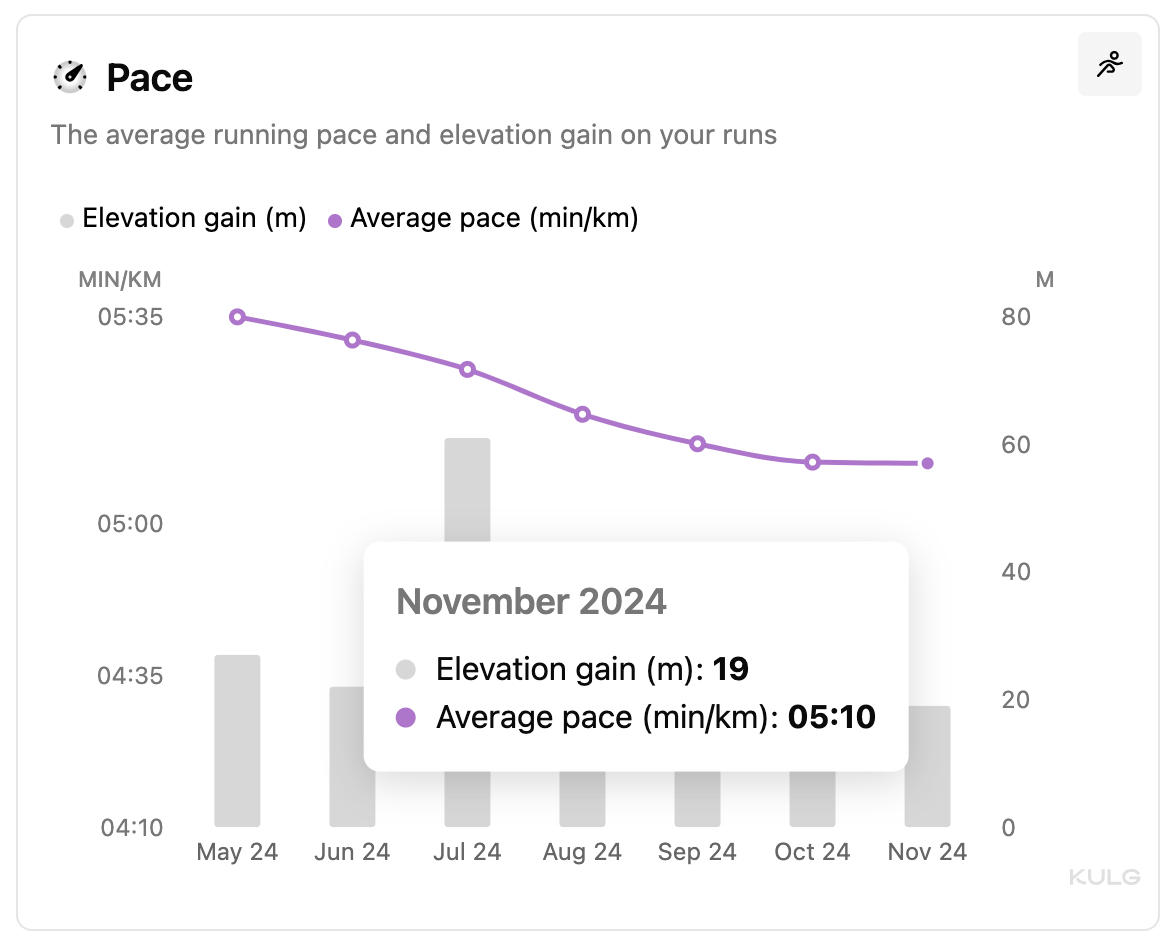
NB! Daily option is available if the selected time frame is within 6 months and weekly if it’s within 1 year.
It is relevant to view the trends of your average pace in the context of your heart rate or perceived effort (RPE; i.e. how hard the run feels). If your average pace is getting faster (trending down), you may be improving or just running harder. It is also important to consider the running conditions and terrain.
If you run faster and your average heart rate remains on the same level, then this is an indicator that your aerobic fitness is improving. In KULG App this is indicated on the HR vs speed graph.
Additionally, the graph is not limited to running. You can select any other sport and view your speed and (if relevant) elevation gain for that sport, giving you a comprehensive overview of all your sports activities.
Tips to understand progress 💡
→ Check your average pace trends in comparison to your average heart rate, perceived effort and high intensity km in the same time frame.
→ Check how your average pace changes for different types of runs where the tracking logic has been the same (e.g. long runs, tempo runs, etc).
→ Check how the average pace changes monthly or quarterly as there may be more fluctuations in short-term - a negative trend in weeks may be a positive one in months.
→ Compare your pace trends, taking seasonality, terrain and elevation gain into account. Your pace may slow down when facing cold, snow, extreme heat, trails, or high altitude.
Data accuracy ⌚️
Elevation gain or total ascent measured by your sports watch can have a margin of error, depending on the technology used. GPS-only watches are slightly less reliable than those with a barometric altimeter. Environmental factors can also reduce GPS signal strength, which may impact the elevation data accuracy.