How to categorise different types of runs?
Written By KULG App
Last updated About 1 month ago
Runner (incl free)
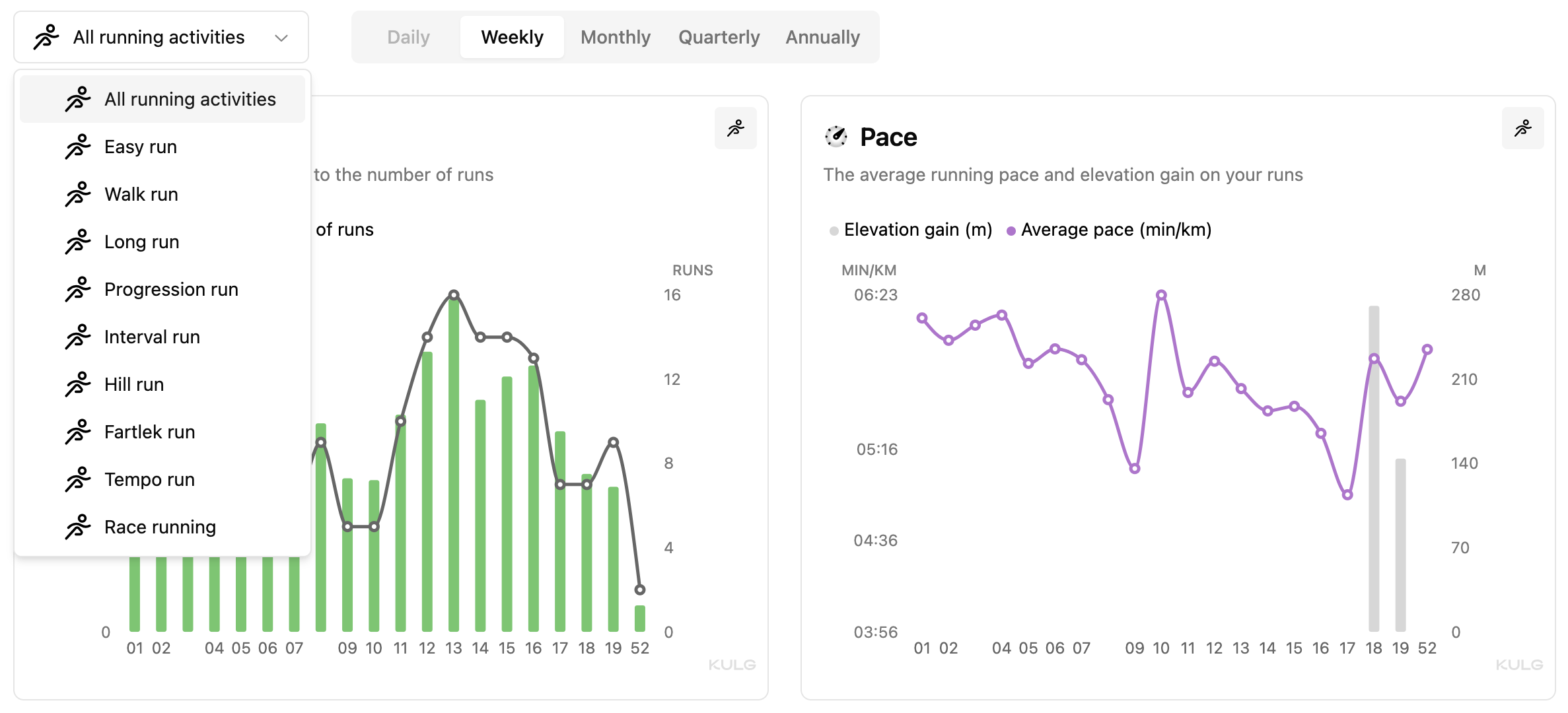
With KULG App, you can categorise your running activities by specific types of runs and filter graphs accordingly. This allows you to compare specific types of runs by distance, duration, pace, heart rate, intensity, or recovery metrics, providing deeper insights into your running progress.
KULG App lets you track high intensity kilometres on all types of runs, so you can see how much of your total running volume felt hard and how much easy (→ read more about how to track high intensity). High intensity could be considered the runs or parts of your runs that you do at heart rate zone 3 or above (higher than ca 80% of your maximum heart rate) or at an effort level of 6 or higher on a 10-point scale.
Sometimes, a run may include a mix of intensities - for example, short repeats at the end of an easy run, tempo segments within a long run, intervals with brief recovery jogs, or hill runs with warm-up, hill repetitions, and cool-down. This means only portions of the run are high intensity. By tracking high-intensity segments within any run type, you can still categorise the activity accurately while capturing your overall intensity correctly.
Different types of runs you can track with KULG App:
Easy run: a low-intensity run aimed at building endurance and promoting recovery without straining the body, done mostly at heart rate zones 1 or 2
Walk run: a running activity that alternates between walking and running intervals, ideal for beginners or those easing back into running, or as a winter training option; e.g. 2 min running and 1 min walking or 5 min running and 2 min walking
Long run: a slower-paced, extended-distance run that builds stamina and prepares you for longer races; it can also be done as a progression run or include tempo segments for added intensity
Progression run: starts at an easy pace and gradually increases to a faster pace, enhancing speed and endurance
Interval run: involves repeated high-intensity intervals, such as 10x200 meters or 5x400 meters, with recovery periods in between; designed to improve speed, endurance, and cardiovascular fitness, often done on a track
Hill run: can include hill repeats, such as 8-10 steady climbs up a moderate hill with recovery jogs down; a continuous hill run on a route with rolling hills; or short hill sprints, like 6-8 quick bursts up a steep incline with full recovery between efforts, all aimed at building strength, power, and endurance
Trail run: involves running on natural terrains such as dirt paths, forest trails, mountains, and rocky landscapes; unlike road running, it often includes uneven surfaces, elevation changes, and obstacles like roots and streams
Fartlek run: a playful run where you vary speed and intensity at random, helping improve both speed and endurance; you can still track roughly how much distance you covered with higher intensity and define it as high intensity kilometres
Tempo run: sustained effort at a comfortably hard pace, typically around 80-90% of your maximum heart rate and slightly below or at race pace, depending on the specific goals of your training and the phase of your periodisation; improves your lactate threshold, helping you maintain a faster pace for longer periods and ultimately enhancing your speed and endurance in races
Race running: all your running races
Tips for choosing the type of run 💡
→ Develop a consistent logic for categorising your runs to be able to filter graphs by running activities - think from the perspective of what you would like to filter out later.
→ For example, all 15+ km runs without longer breaks could be categorised as long runs; all easy/ slow/ recovery runs, warm-ups, cool-down runs as easy runs.
→ In order to see how your tempo runs or intervals progress over time, record your tempo runs or longer intervals as separate activities.
NB! 📍
If you would like to track other types of runs, please let us know here by creating a post.